Gestalt Language Processing (GLP)

Your child is likely a Gestalt Language Processor (GLP) if:
Their speech is characterized as echolalia or "scripting"
They do/did not respond well to traditional speech therapy approaches (such as increasing vocabulary or modelling language expansion)
They struggle with self-generated language and/or grammar
Single words tend to stay single words instead of being combined to form phrases
Their language appears to be inflexible to new contexts
They are Autistic! Up to 85% of Autistic individuals are gestalt language processors
If this sounds familiar, there is no cause for concern!
GLPs are on their own language development path, and it can end at the same destination as an analytic language processor: original, flexible language. Keep reading to learn about the basics of Gestalt Language Processing.
Two Types of Language Development...
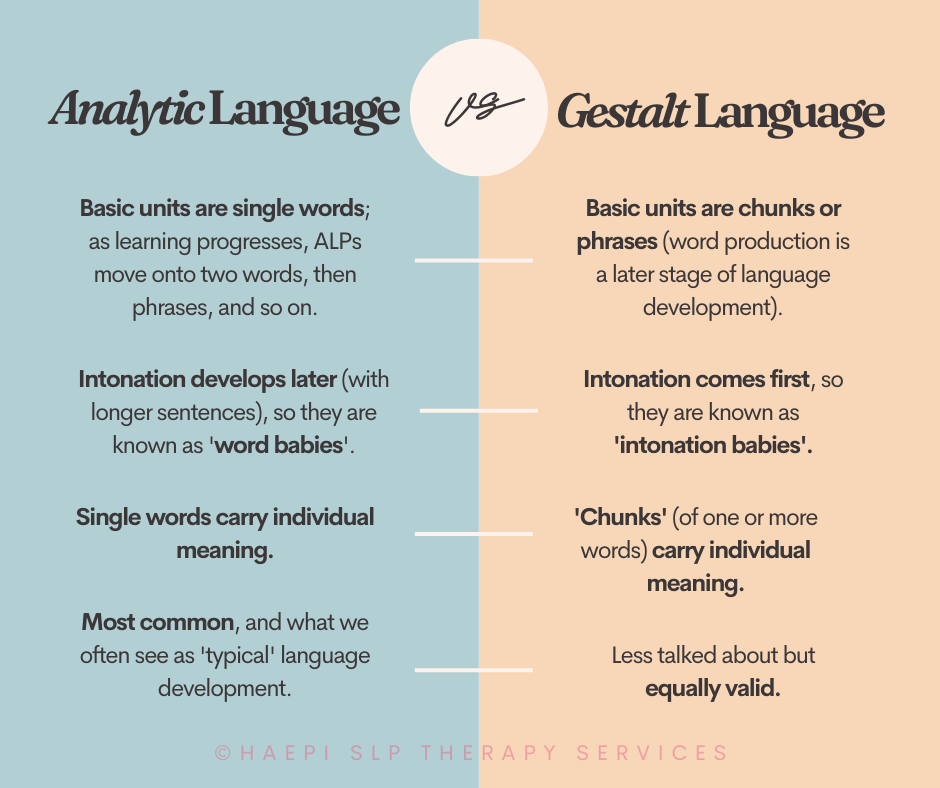
Analytic language development and gestalt language development are two ways to process and develop language, and many people think of analytic language development as the “standard" method of developing language (using words first as the building blocks to produce sentences). Children who use gestalt language development, however, process language in whole chunks instead of single words (at first). The important thing to remember is that both analytic language development and gestalt language development are normal and natural!
This graphic outlines the differences between these two equally valid forms of language development.
Echolalia (aka Gestalts)
While everyone uses some echolalia, echolalia is the essential part of language development for gestalt language processors.
There are two types of echolalia—immediate and delayed. Immediate echolalia refers to language that is repeated immediately or after a brief delay. Delayed echolalia refers to language that is repeated after a significant delay. Gestalt language processors may use both immediate echolalia and delayed echolalia, however delayed echolalia, or the use of gestalts, is the type of language that makes up the first Stage of Natural Language Acquisition for our gestalt language processors.
Natural Language Acquisition
Traditional speech therapy approaches have historically approached language development of all children through an analytic language processing lens. A gestalt language processor would struggle to make progress toward self-generated language and grammar use because of this. Gestalt language processors' language development does not need to be "fixed," it needs to be supported naturally.
Natural Language Acquisition (NLA) describes the natural development of language for gestalt language processors. In other words, a gestalt language processor goes through Stages of Natural Language Acquisition (NLA) in order to develop language, beginning with whole gestalts and eventually learning to recognize single words as individual units of language. Once a child is able to ‘free’ these words through the process of mitigation, the child gains *flexibility* in their language which allows them to produce self-generated phrases!
A speech-language pathologist who has an understanding of NLA (such as myself!) will provide assessment and treatment that is:
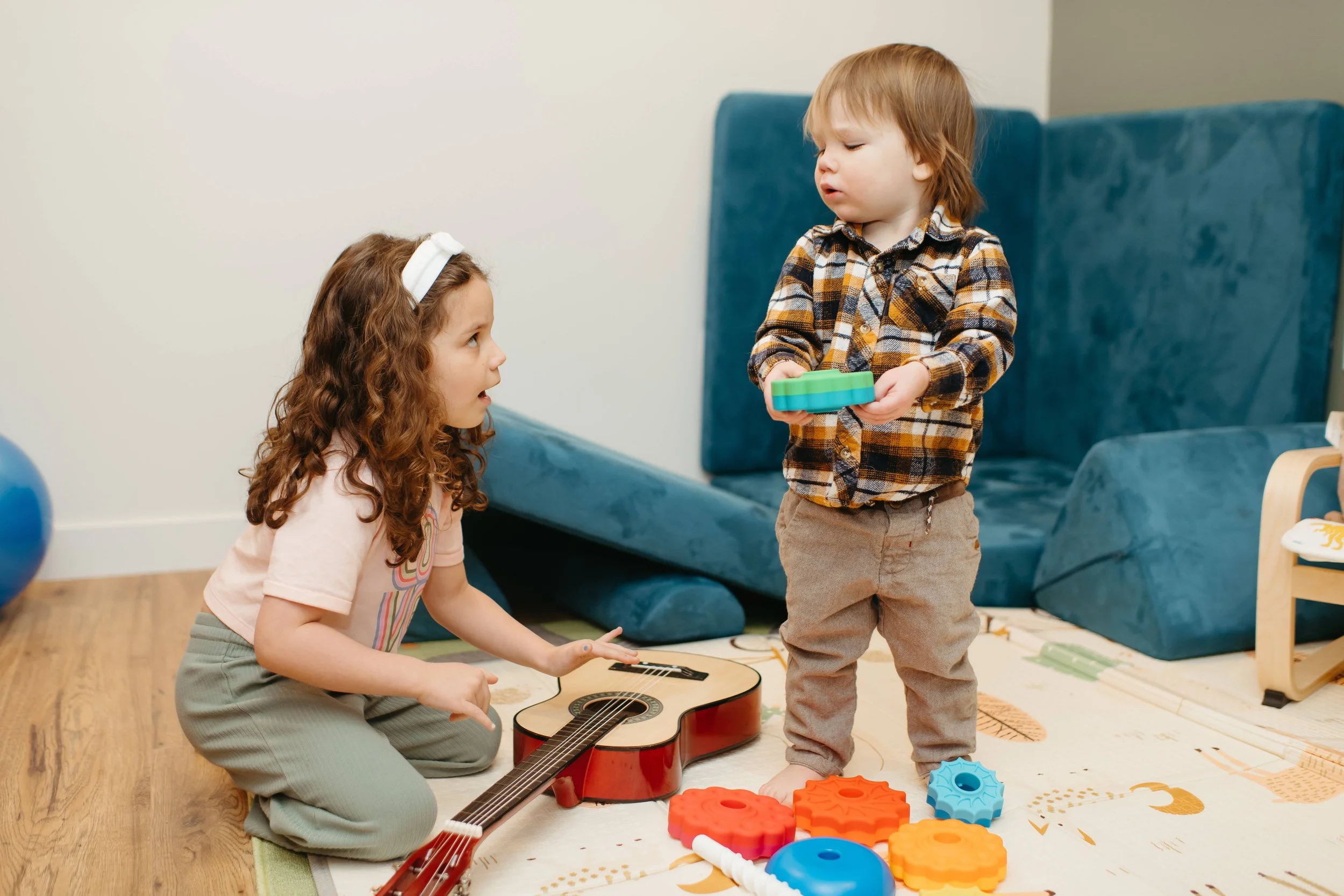
child-led and play-based (e.g., intrinsically motivating to the child),
provided with sensory preferences and supports in mind (e.g., using AAC if needed), and
provided through an NLA lens using NLA-based supports.
Frequently Asked Questions
-
Gestalts (or "scripts") are the repetition of words or phrases heard that are used verbatim after some time has passed. A gestalt may be used after the child has heard it from its original source hours, days, weeks, or even years later. It is a "chunk" of language stored in a child's memory for later use. It is often tied to an emotional experience for the child, and each gestalt carries a unique meaning to the child.
-
GLPs follow the stages of Natural Language Acquisition (NLA) to move from echolalia to self-generated (unique and flexible) language. Some GLPs will move through the stages completely independently, but some Autistic GLPs may need extra support moving through the stages. See below for a very brief overview of NLA Stages 1-4:
Stage 1 - ECHOLALIA: Scripting gestalts or intonation patterns exactly as they were once heard (delayed echolalia)
Stage 2 - MITIGATION: Mix-and-matching parts of gestalts
Stage 3 - SINGLE WORD & 2-WORD COMBINATIONS: Isolating single words and beginning to combine referentially with other single words
Stage 4 - ORIGINAL PHRASES & BEGINNING GRAMMAR: Combining single words to make new, self-generated sentences that use both nouns and verbs (beginning grammar)
-
Because gestalt language processors (GLP) are "intonation babies," they often hear a stream of sound and listen for the breaks in our utterances, songs, and lines from movies. Remember, gestalts are one whole unit for a GLP. A gestalt is not made up of individual words for them, but rather it is one "chunk." The intonational pattern of the gestalt is often what matters most to the GLP, and may sound like gibberish to the untrained ear. We often have to do some "detective work" to figure out where a gestalt originates from and what it means to the child!
-
Just speak naturally! Understand that echolalia is meaningful, and a GLP is communicating with it. GLPs in the early stages of acquiring language will benefit more from the use of 'declarative language' rather than responding to questions. Comment on the world around you without setting expectations for a certain answer. GLPs progress in a different way and pace than ALPs, so understand that their path to flexible, self-generated language is not wrong - it's just different!
-
Yes! A child who is a GLP will always be a GLP - but as they move through the stages, their language will remain flexible. Just because someone is a GLP does not mean they will always use echolalia. We also know from Autistic adults that in moments when there are more sensory or emotional demands, GLPs may prefer to use gestalts to communicate.
Other Areas of Focus