Speech Disorders
A speech disorder is a condition in which an individual has difficulty creating or forming the speech sounds that are needed to effectively communicate with others.
This can not only make the person's speech difficult to understand, but can also be incredibly frustrating and disheartening for them to experience. Read below about some common speech disorders that HAEPI can both assess and treat.
Articulation (Speech Sounds)
Articulation refers to the actions of the lips, tongue, jaw, and palate in producing the sounds of speech.
Some children experience difficulty acquiring these actions correctly, and the result is speech that is unclear (and sometimes even unintelligible). This is known as an articulation delay or disorder, which comprises 50-80% of all communication disorders!
Keep in mind that a child's speech should be easily understandable by the time they reach age 3. While the presence of some errors in articulation is normal, a child should be able to make all speech sounds correctly by age 7.
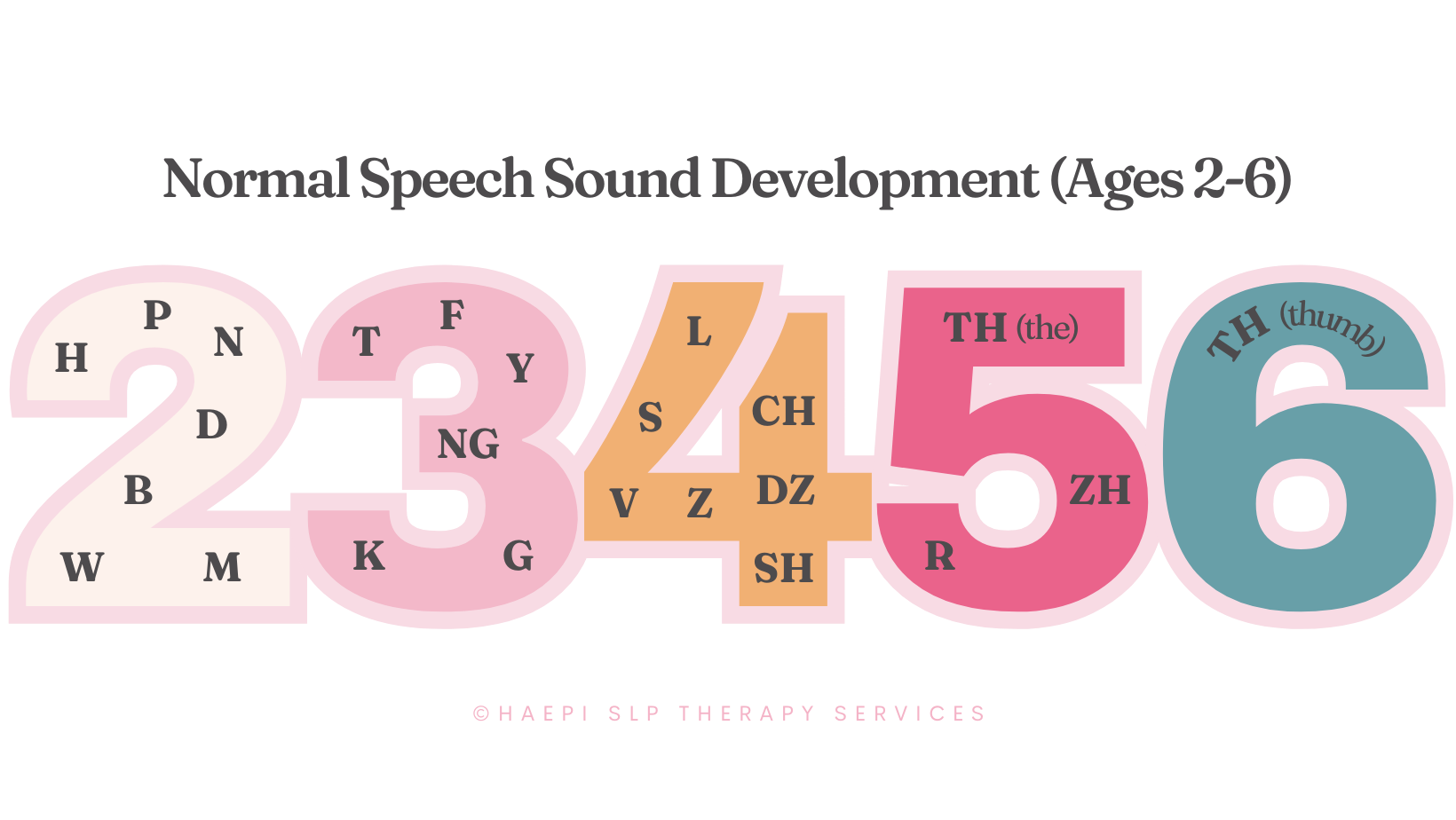
Typical progress looks like...
1 ½ – 2 years: b, p, m, w, h
2 years: n, t, d, f, y
2-3 years: k, g, ng
3-4 years: s, z, v
3-5 years: l
3 ½ – 6 years: sh, ch, j
4-6 years: r, th, consonant blends

If you have any concerns about your child’s articulation (or if your child is 3 years or older and is still hard to understand), contact us to get started with intervention. In some cases, the correction of these errors may be quite quick if your child is physically ready to make the correct sounds.
Save the following graphic to make sure your child's language development stays on track!
Phonology
In some cases, a child may be using speech patterns that are incorrect. This can look like...
Final Consonant Deletion – leaving off the ends of words
Fronting – substituting a /t/ or /d/ sound for /k/ and /g/ sounds by using the front of the tongue instead of the back
Stopping – substituting a consonant that stops (e.g., t, d, k, g) for consonants that continue (e.g., s, f, sh)
Cluster reduction – simplifying a consonant blend to only one consonant (e.g., wim for swim)
The existence of these error patterns (or phonological processes) often results in speech that is very difficult to understand. If your child is experiencing the challenge of unintelligible speech, contact us for assessment and intervention.

Fluency (Stuttering)
Between the ages of 2-4, many children go through a period when their speech is dysfluent. Repetition of words and phrases is a normal aspect of rapid growth in language development, but sometimes real stuttering can begin to present itself at this age. The presence of many of the following risk factors suggests it may be a good idea to seek an intervention by an SLP:
Male (there is a 4:1 higher incidence of stuttering among males)
Family history of stuttering
Repetitions persisting > 3 months
Sound repetitions
Physical tension
Blocks (no sound despite visible effort)
Treatment for fluency includes learning different fluency-enhancing strategies, and helping build an individual’s confidence during moments of disfluency. Contact us to learn more!

Other Areas of Focus